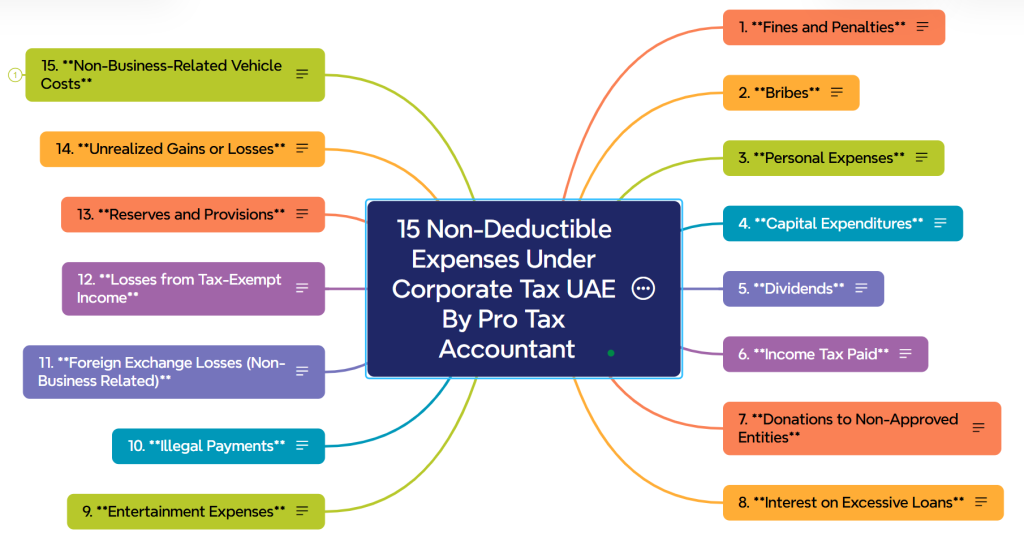
Under the UAE Corporate Tax Law (Federal Decree-Law No. 47 of 2022), non-deductible expenses include: bribes and illicit payments, statutory fines and penalties, 50% of entertainment and hospitality costs, dividends and profit distributions, personal expenses of owners, interest expense exceeding 30% of adjusted EBITDA (above AED 12 million), payments to related parties above arm’s length value, donations to non-qualifying organisations, and costs attributable to exempt income. These must be added back when computing taxable income subject to the 9% UAE Corporate Tax rate.
The UAE introduced Corporate Tax at 9% on taxable income exceeding AED 375,000, effective for financial years starting on or after 1 June 2023. One of the most consequential tasks for every UAE business is correctly separating deductible expenses from non-deductible ones before filing the Corporate Tax return with the FTA.
Getting this wrong — either by over-claiming deductions or missing disallowed items — can trigger FTA penalties, back-tax assessments, and interest charges. This guide covers every category of non-deductible expense under UAE law with practical examples relevant to businesses operating in Dubai, Abu Dhabi, and across all emirates.
What Makes an Expense Non-Deductible Under UAE Corporate Tax?
The starting point for UAE Corporate Tax is the accounting profit prepared under International Financial Reporting Standards (IFRS), as required under the CT Law. From that figure, specific adjustments are made — non-deductible expenses are added back — to arrive at taxable income.
An expense is generally deductible only if it is:
- Incurred wholly and exclusively for a business purpose
- Not capital in nature (capital items are depreciated, not immediately expensed)
- Not prohibited under the CT Law or Ministerial Decisions
- Supported by adequate documentation (invoices, contracts, bank records)
If any condition fails, or the expense falls into a prohibited category, it is non-deductible.
Complete Reference: Non-Deductible Expenses Under UAE CT Law
| # | Expense Category | Status | CT Law Reference | Key Note |
|---|---|---|---|---|
| 1 | Bribes, kickbacks & illicit payments | 100% Non-Deductible | Article 33 | Disallowed regardless of commercial reason |
| 2 | Statutory fines & regulatory penalties | 100% Non-Deductible | Article 33 | FTA, DED, MOHRE fines; contractual penalties may differ |
| 3 | Entertainment & hospitality | 50% Deductible Only | Article 32 | Client meals, gifts, events — 50% always disallowed |
| 4 | Dividends & profit distributions | 100% Non-Deductible | Article 28 | Appropriation of profit, not a business cost |
| 5 | Personal expenses of owners / shareholders | 100% Non-Deductible | Article 28 | School fees, personal cars, home rent routed through company |
| 6 | Net interest above EBITDA cap | Excess Non-Deductible | Article 30 | Cap: higher of AED 12M or 30% of adjusted EBITDA |
| 7 | Related-party excess payments | Excess Non-Deductible | Articles 34–36 | Amounts above arm’s length value disallowed |
| 8 | Donations to non-qualifying bodies | 100% Non-Deductible | Article 33 | Only Cabinet-approved public benefit entities qualify |
| 9 | Costs related to exempt income | Non-Deductible | Article 28 | Expenses to earn qualifying dividends / Free Zone exempt income |
| 10 | Capital expenditure (in-year write-off) | Non-Deductible (year of purchase) | Article 27 | Deducted via depreciation over useful life instead |
| 11 | Recoverable input VAT | Non-Deductible | Article 28 | VAT the business can reclaim from FTA is not a cost |
| 12 | UAE Corporate Tax itself | Non-Deductible | Article 33 | Tax on profit cannot reduce the same profit |
1 Bribes, Kickbacks & Illicit Payments
Article 33 of the UAE Corporate Tax Law absolutely prohibits any deduction for payments constituting bribery or corruption — regardless of the commercial rationale or how they are labelled in the accounts. This covers:
- Payments to government officials (UAE or foreign)
- Undisclosed commissions or kickbacks to business partners
- Facilitation payments to expedite government processes
- Any payment violating UAE anti-corruption legislation (Federal Law No. 31 of 2006)
2 Statutory Fines & Regulatory Penalties
Fines imposed by UAE government authorities are fully non-deductible under Article 33. These include:
- FTA penalties — late VAT filing, incorrect returns, CT registration delays
- DED (Department of Economic Development) trade licence fines
- Ministry of Human Resources (MOHRE) labour law penalties
- Municipality penalties and building code fines
- Court-ordered regulatory fines and surcharges
3 Entertainment & Hospitality — The 50% Rule
Under Article 32, entertainment, amusement, and recreation expenses are only 50% deductible. The disallowed 50% must be added back to accounting profit when computing taxable income. This catches many UAE businesses off guard.
Expenses subject to the 50% restriction include:
- Client and prospect meals at restaurants
- Corporate hospitality events, gala dinners, award nights
- Client gifts (where the primary purpose is entertainment)
- Golf days, sporting events, and leisure activities for clients
- Hotel accommodation provided for entertainment purposes
- Staff parties where clients are the beneficiaries
4 Personal Expenses of Owners & Shareholders
Personal costs routed through a company are fully non-deductible and one of the most common FTA audit findings in UAE SMEs. Examples:
- School fees for children of shareholders or partners
- Personal vehicle lease, insurance, and fuel (non-business use)
- Rent for a shareholder’s personal residence
- Personal holidays or leisure travel
- Luxury goods, personal shopping, and lifestyle expenses
- Medical expenses beyond standard employee benefit packages
5 Net Interest Expense — The 30% EBITDA Cap
Under Article 30 (General Interest Deduction Limitation Rule), net interest expense deductions are restricted to the higher of:
- AED 12 million per tax period, OR
- 30% of adjusted EBITDA — see our guide on understanding EBITDA for the calculation
Net interest exceeding this cap is non-deductible in the current year. However, it can be carried forward for up to 10 tax periods.
Example: A Dubai company has AED 5M net interest expense and adjusted EBITDA of AED 10M. The 30% cap = AED 3M. The excess AED 2M is non-deductible this year but carries forward.
6 Related-Party Payments & Transfer Pricing
Under Articles 34–36, transactions between related parties must reflect the arm’s length principle — the same terms unrelated parties would agree to in a comparable transaction. Where a payment exceeds arm’s length value, the excess is non-deductible.
Common related-party transactions affected:
- Management fees from a parent company above market rates
- Intra-group loans with above-market interest rates
- Royalties or IP licensing fees to related offshore entities
- Rent between related companies above the market rate
- Shareholder salaries that significantly exceed market compensation
Businesses with related-party transactions exceeding AED 40 million must maintain a Master File and Local File as transfer pricing documentation, ready for FTA review.
7 Donations to Non-Qualifying Organisations
Only donations to Qualifying Public Benefit Entities listed under Cabinet Decision No. 37 of 2023 are deductible. Donations to unregistered charities, foreign NGOs not on the approved list, religious institutions not approved by Cabinet, and individuals — however deserving — are non-deductible.
Before making a donation and claiming it as a deduction, verify the entity’s status on the FTA approved list at tax.gov.ae.
8 Expenses Relating to Exempt Income
If your business earns exempt income — such as qualifying dividends via the Participation Exemption, or Free Zone qualifying income — expenses directly attributable to generating that exempt income are non-deductible against taxable income. You cannot both exempt the income and deduct the related costs.
9 Capital Expenditure & Depreciation
The immediate write-off of capital expenditure is not permitted. A fixed asset purchase must be capitalised on the balance sheet and depreciated over its useful life. Only the annual depreciation charge is deductible — not the full purchase cost in year one.
Depreciation on assets used for personal purposes or to generate exempt income is not deductible. Only the business-use portion of a mixed-use asset qualifies.
10 UAE Corporate Tax Itself
The corporate tax paid to the FTA is explicitly non-deductible under Article 33. A tax on profit cannot reduce the same profit it is charged on — allowing it would create a circular reduction. The same rule applies to foreign taxes for which a UAE tax credit is claimed.
Struggling to Identify What’s Deductible in Your Books?
Our ACCA-certified accountants perform a complete review of admissible and inadmissible expenses before every corporate tax return — so you maximise your allowable deductions and avoid FTA penalties. From AED 750/month, all-inclusive.
💬 Chat With a UAE Tax ExpertHow Non-Deductible Expenses Are Treated in the Tax Return
The UAE Corporate Tax return begins with net accounting profit prepared under IFRS, then applies the following adjustments to arrive at taxable income:
| Line Item | Adjustment | Effect on Taxable Income |
|---|---|---|
| Net Profit per IFRS Financial Statements | Starting point | — |
| Add: Non-deductible expenses (bribes, fines, personal costs, 50% entertainment etc.) | + | Increases taxable income |
| Add: Excess interest expense disallowed under IDLR | + | Increases taxable income |
| Deduct: Exempt income included in accounts (qualifying dividends etc.) | − | Reduces taxable income |
| Deduct: Tax loss carryforward offset (up to 75% of taxable income) | − | Reduces taxable income |
| = Taxable Income | Apply 9% on amount exceeding AED 375,000 | |
Separately, the FTA also compares your declared taxable income against the pattern of your expenses. Unusual ratios — very high “other expenses” or “consulting fees” — are common triggers for a UAE tax audit.
Penalties for Incorrectly Claiming Non-Deductible Expenses
If the FTA determines that non-deductible expenses were claimed, the consequences compound quickly:
- Additional corporate tax — 9% on the disallowed deduction amount
- Administrative penalty — AED 1,000 for a first-time minor error up to 300% of unpaid tax for deliberate evasion
- Late payment penalty — 14% per annum on the outstanding tax balance
- Compliance risk flag — FTA maintains a risk score per taxpayer; one audit finding increases the likelihood of future audits
All-Inclusive Accounting & Corporate Tax Package
ACCA-certified, FTA-compliant accounting and corporate tax services. Accounting maintained as per International Financial Reporting Standards (IFRS) as applicable in the UAE. A dedicated accountant and relationship manager is allocated to your company.
What’s included:
- Recording of day-to-day transactions — payments, receipts, sales, purchases & miscellaneous expenses (monthly)
- Monthly Bank Reconciliation Statements (BRS)
- Monthly aging reports — trade receivables and trade payables
- Monthly financial reports — Balance Sheet and Profit & Loss Account
- VAT registration with FTA (if applicable)
- Preparation of VAT return workings (if applicable)
- Submission of VAT returns to FTA (if applicable)
- Determination of admissible and inadmissible (non-deductible) expenses
- Calculation of taxable profits
- Preparation of Corporate Tax Return working
- Submission of Corporate Tax Return to FTA
- Annual external audit of financial statements
- Dedicated accountant & relationship manager allocated to your business
No office visit required. Serving Mainland, Free Zone, and Offshore companies across the UAE.
💬 Get Started on WhatsApp — AED 750/monthFrequently Asked Questions
Get Your Corporate Tax Right the First Time
ProTax’s ACCA-certified team handles your complete accounting, VAT, and corporate tax compliance — including identifying every non-deductible expense and filing your FTA return on time. No office visit required. Dedicated accountant allocated to your business. From AED 750/month.
💬 WhatsApp Us Now — Free Consultation